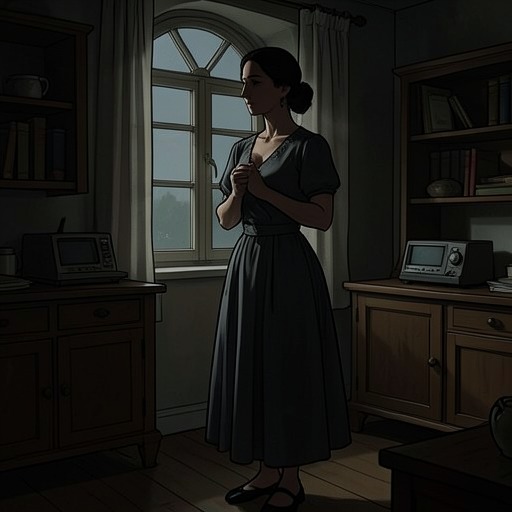
Werther’s final visit to Charlotte
The Sorrows of Young WertherWerther’s final visit to Charlotte brings their intimacy to its most dangerous and decisive point. A reading from Werther’s translation of Ossian draws them into a shared grief that seems to mirror their own predicament; the emotional communion gives way to a passionate embrace, then to Charlotte’s firm rejection and a final separation. The scene turns longing into rupture, while the stormy departure that follows carries the encounter’s distress into the night.
Before the Visit
At half-past six, Charlotte heard Werther on the stairs and recognized his voice asking whether she was at home. Her heart beat audibly at his arrival. When he entered, she reproached him for not keeping his word; he replied that he had promised nothing. She urged him to comply for her sake, and then for both their sakes, making plain that the visit was already charged with consequences neither could comfortably name.
Charlotte scarcely knew what she was saying or doing. She sent for friends, hoping their presence would prevent her from being left alone with Werther, yet she also found herself hoping they would not arrive. Her uncertainty extended to whether the servant should remain in the adjoining room. Werther paced impatiently while she went to the piano, resolved not to withdraw. At last she gathered herself and sat beside him on the sofa, where he usually sat. These small choices make the scene’s central conflict visible before either speaks of it: Charlotte seeks the protection of distance even as she is drawn toward his company.
The encounter also follows an inward struggle that Charlotte has not expressed to Werther. She has considered her intimate friends as possible recipients of him, but each seems objectionable, and she can choose none. Beneath those judgments she recognizes a real wish to keep Werther for herself; that wish oppresses her and clouds any prospect of happiness. The visit therefore begins not with a settled decision, but with competing impulses—welcome, resistance, and an effort to keep the meeting from becoming private.
The Reading and Shared Grief
When Charlotte asks whether he has brought something to read, Werther says he has not. She directs him to a drawer, where he will find his own translation of songs from Ossian. She has not read them because she had hoped to hear him recite them, a wish she has been unable to fulfill for some time. Werther smiles, retrieves the manuscript, and shudders as he takes it. Then, seated, with tears in his eyes, he begins reading.
The verses summon a world of remembered companions and losses. Werther recites of Fingal and the gathered heroes, and of the singers Ullin, Ryno, Alpin, and Minona; the passage moves from the vanished fellowship of earlier days to a father’s grief for a daughter who dies after crying out alone on a storm-beaten shore. The lament ends with the vision of children’s ghosts walking together by the setting moon. The poem’s grief is not merely an object Charlotte and Werther contemplate: as the narration states, they feel that the misfortunes of Ossian’s heroes picture their own fate, and they feel this together.
Charlotte’s tears, streaming so freely that they relieve her bursting heart, stop Werther’s recitation. He throws down the book, seizes her hand, and weeps; she buries her face in her handkerchief. Werther rests his forehead on her arm. Charlotte trembles and wishes to leave, but sorrow and sympathy weigh upon her. She soon recovers herself enough to beg him, through broken sobs, to go. He is shaken, yet takes up the book and begins again, his voice breaking with sobs. Their emotional closeness is thus sustained by the reading even as Charlotte tries to end the encounter.
Recognition and Rupture
The next poem passage addresses spring as a force that awakens what is already approaching decay: the speaker welcomes its heavenly dew but foresees the storm that will wither its leaves and the traveler who will return to find it gone. Its words strike Werther with their full force. In despair he throws himself at Charlotte’s feet, takes her hands, and presses them to his eyes and forehead. Only then does Charlotte apprehend, for the first time, his fatal project.
Her response is immediate but conflicted. She holds his hands and presses them to her bosom, leaning toward him with tender pity until her cheek touches his. They lose sight of everything around them. Werther clasps her, draws her to him, and kisses her trembling lips. Charlotte calls his name faintly and turns away, at first pushing him back with a feeble hand. She then speaks his name again with a firm voice. Werther resists no further and tears himself from her arms, falling to his knees before her.
Charlotte rises in grief mixed with love and resentment and declares that this is the last time and that he will never see her again. After one last tender look, she rushes into the adjoining room and locks the door. Werther holds out his arms but does not detain her. He remains on the ground with his head against the sofa for half an hour, until a noise brings him back to his senses. When the servant enters and later leaves him alone, Werther goes to Charlotte’s door, calls to her in a low voice, and asks for one last farewell. She gives no answer. After listening and pleading in vain, he tears himself away, calling his farewell to her final.
Departure and Immediate Aftermath
Werther runs to the town gate. The guards know him and let him pass in silence. The night is dark and stormy, with rain and snow. He reaches his house at about eleven without his hat; his servant sees him enter but does not dare speak. While helping Werther undress, the servant finds his clothes wet. The hat is later discovered on a point of rock overhanging the valley, and the account emphasizes how difficult it is to understand how Werther climbed there in such darkness and tempest without losing his life.
Werther goes to bed and sleeps late. The following morning, when his servant is called to bring coffee, he finds Werther writing. Werther is adding a message addressed to Charlotte. The visit has ended, but its immediate consequence is not silence: the morning after the locked door and unanswered farewell, Werther turns again to a written address to her.
Narrative Significance
The scene’s decisive movement is from mediated feeling to embodied action. The manuscript first lets Werther and Charlotte share grief at a distance, through the misfortunes of Ossian’s figures; their recognition that the poem reflects their own fate narrows that distance. Charlotte’s sympathy becomes physical closeness, but Werther’s embrace crosses a boundary she ultimately enforces. The reading therefore does not resolve their conflict. It intensifies it until Charlotte must turn shared emotion into separation.
The encounter also changes what Charlotte understands: she had been trying to manage the visit and her own conflicted attachment, but Werther’s despairing gesture makes her recognize the danger of his intentions. Her last declaration and locked door establish a final limit, while the unanswered appeal and storm-lit journey show that Werther cannot readily detach himself from her. His hat on the rock and his wet clothes preserve the peril of the night as concrete aftermath; the next morning’s writing carries the separation forward into another address to Charlotte.